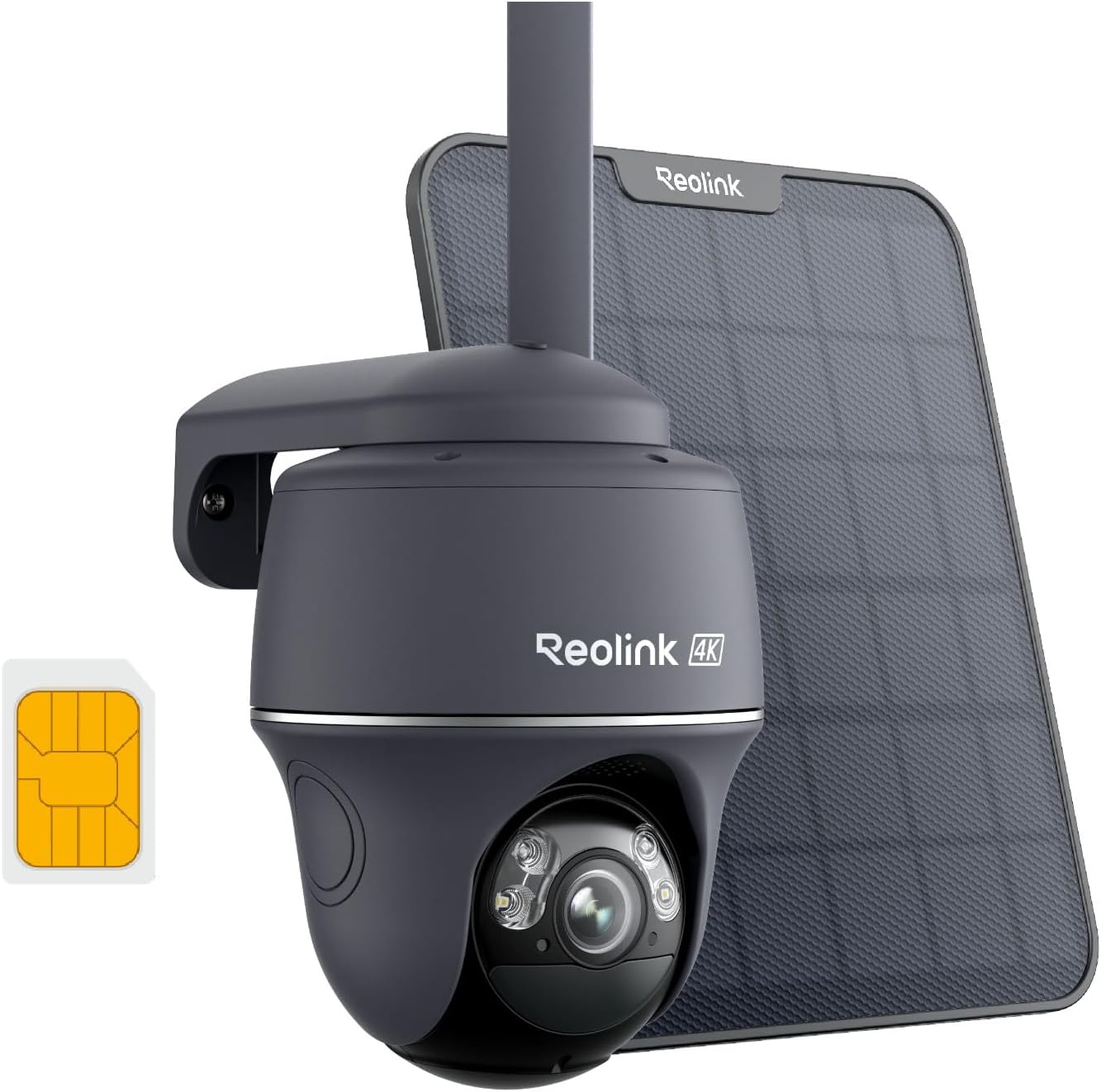


Price: $229.99 $144.99
(as of 2026-11-23 02:23 GMT+0000 – Details)

Product Concept and Intended Use Cases
The REOLINK 4K Solar Security Camera is positioned as a completely wire‑free surveillance solution that combines ultra‑high‑definition video with cellular connectivity. By integrating a solar panel and a 4G LTE modem, the device eliminates the need for mains power or a local Wi‑Fi network, making it suitable for remote or off‑grid locations such as country homes, construction sites, farms, and other properties where running cables is impractical. The camera’s design targets users who require continuous monitoring without relying on existing infrastructure, and it ships with a prepaid Reolink SIM card that can be activated and managed through the companion mobile application. This architecture allows the unit to operate autonomously as long as sunlight is sufficient to keep the internal battery charged and a cellular signal is available.
4K Imaging Performance Day and Night
The camera captures video at a 4K resolution, providing a level of detail that enables identification of faces, license plates, and other fine features across a wide field of view. The description emphasizes “crystal‑clear 4K imaging, day or night,” indicating that the sensor and infrared illumination are engineered to maintain image quality in low‑light conditions without the need for external lighting. In practice, this means the device can record usable footage around the clock, though actual night‑time range and clarity will depend on ambient light levels, weather, and the reflectivity of the scene. No specific infrared distance or low‑lux rating is supplied, so expectations should be calibrated to typical 4K outdoor cameras that rely on built‑in IR LEDs for night vision.
Solar Power and 4G LTE Connectivity
Solar‑powered operation is achieved through an integrated panel that charges an internal battery, allowing the camera to function without any wired power source. The 4G LTE modem provides the data link, so the unit does not depend on a local Wi‑Fi router. This combination is advantageous for sites lacking electricity or internet service, but it also introduces dependencies: consistent sunlight is required to sustain battery health, and cellular coverage must be reliable enough to stream or upload footage. The product description notes that the camera “operates entirely wire‑free—no need for external power or Wi‑Fi,” which underscores the design goal of true independence, yet users in heavily shaded or high‑latitude areas may experience reduced uptime during winter months or prolonged overcast periods.
Pan, Tilt, and Coverage Mechanics
The mechanical head offers 355° of horizontal rotation and a vertical pitch of 90°, described as “355° Pan & 140° Tilt for Complete Coverage” in the title but detailed as 90° vertical in the specification text. This range enables the camera to sweep a broad area and automatically track a moving target’s trajectory, recording the path throughout an event. The near‑full horizontal sweep minimizes blind spots, while the vertical range allows the lens to look down toward the ground or up toward the horizon. However, the pan/tilt mechanism is motorized, which consumes additional power from the solar‑charged battery and may introduce mechanical wear over time. The automatic tracking feature relies on the camera’s detection algorithms to initiate movement, so its effectiveness is tied to the accuracy of those algorithms.
Multi‑Carrier SIM and App‑Based Management
A prepaid Reolink SIM card is included, and the device can automatically connect to the strongest available network among AT&T or T‑Mobile in the United States. This intelligent signal switching aims to maintain connectivity when one carrier’s signal degrades. The Reolink app provides a user interface for activating the SIM, topping up data plans, and monitoring data consumption in real time. This approach simplifies deployment because no separate carrier contract is required, but it also means ongoing costs are tied to Reolink’s data pricing and the user must manage plan renewals through the app. Data usage will vary with video quality settings, motion‑triggered recording frequency, and whether continuous streaming is enabled, so budgeting for cellular data is a practical consideration.
Smart Detection, Alerts, and Limitations
The camera incorporates free human, vehicle, and animal recognition to filter out irrelevant motion such as swaying branches or falling leaves. By classifying detected objects, the system aims to reduce false alarms and only record or notify on events deemed valuable. Custom alerts can be configured in the app to match specific monitoring goals. While this on‑device intelligence improves relevance, its performance depends on the training data and processing capacity of the embedded chipset; complex scenes, poor lighting, or partially obscured subjects may still generate missed detections or occasional false positives. Additionally, the detection logic operates before the pan/tilt tracking engages, so the camera must first recognize a target before it can follow it, which may introduce a brief latency in fast‑moving scenarios.